

"The greatest love story ever told was never about finding your beloved. It was about becoming capable of divine union."
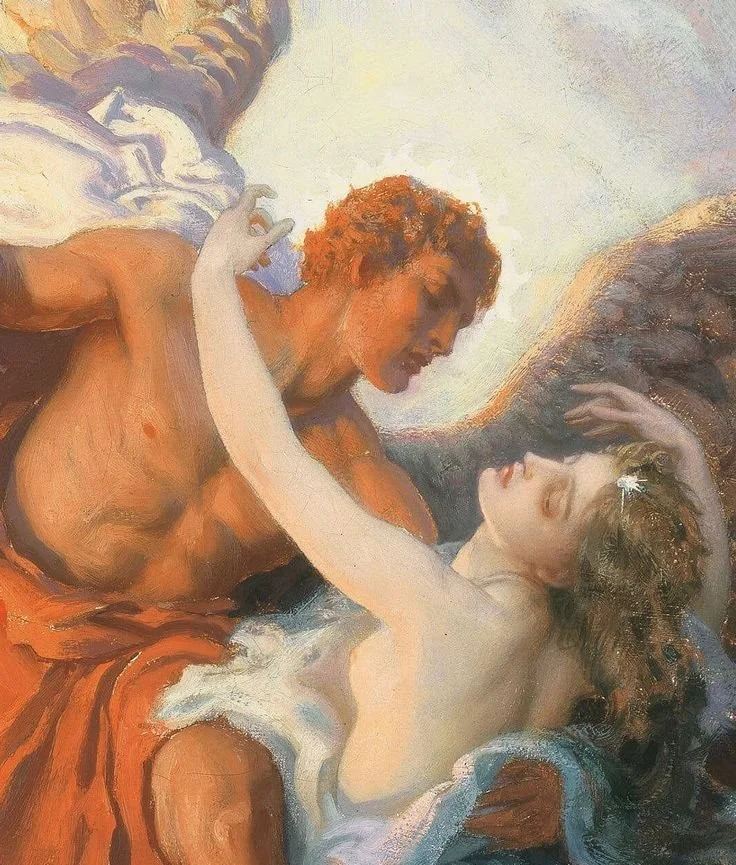
The myth of Psyche and Eros is often remembered as one of the greatest romance stories in Greek mythology. A mortal woman falls in love with a god, loses him, completes impossible trials, and is eventually reunited with her beloved.
But I don't believe this is fundamentally a story about romantic love.
I believe it is a story about the evolution of the feminine soul.
To me, Psyche represents the human soul. Eros is divine love itself. Their relationship is the meeting between the human and the sacred, and the myth asks a timeless question:
How do we become capable of experiencing oneness with the Divine?
The Woman Who Had Everything Except Love
Psyche was said to be the most beautiful woman in the world. Her beauty was so extraordinary that people stopped making offerings at the temples of Aphrodite and instead traveled simply to admire Psyche.
Yet despite being adored, she was profoundly lonely.
No man dared ask for her hand in marriage. She was admired from a distance but never truly known. She longed for love, intimacy, and companionship, but instead found herself isolated by the very beauty everyone envied.
I think there is something deeply symbolic in this.
How many women have been admired yet unseen? Desired yet untouched emotionally? Praised for their beauty while quietly wondering why they still feel incomplete?
Beauty alone could never satisfy Psyche's soul.
Aphrodite Wasn't Destroying Her
Most modern retellings describe Aphrodite as jealous—a woman threatened by another woman's beauty. She sends her son Eros to curse Psyche by making her fall in love with the ugliest man alive.
I've never believed that interpretation.
Through the lens of Feminine Astrology, Aphrodite is Venus. She represents beauty, yes, but also creativity, purpose, values, and the force that calls us into the fullest expression of ourselves.
What if Aphrodite wasn't trying to destroy Psyche?
What if she was trying to initiate her?
For many women, there may be no greater suffering than pouring their heart into someone incapable of meeting them. We become so consumed with loving another that we slowly abandon ourselves.
Perhaps Aphrodite understood something Psyche didn't yet know.
The woman who sought completion through love would never be capable of divine love.
She first had to become whole.
Falling in Love with a God
Aphrodite sends Eros to carry out the curse.
Instead...
Eros falls in love with Psyche.
He carries her away to a magnificent palace where he visits her only under the cover of darkness. Every night they experience an ecstatic, transcendent love unlike anything Psyche has ever known.
There is only one condition.
She must never look upon his face.
To me, this is one of the most beautiful metaphors for spiritual awakening ever written.
Eros is a god.
His love represents communion with something beyond the ordinary human experience. When we first touch the Divine—whether through meditation, nature, creativity, a relationship, or a mystical experience—we simply know.
We don't ask for proof.
We don't need certainty.
The experience itself is enough.
When the Ego Wants Proof
Everything changes when Psyche's sisters come to visit.
They begin planting seeds of doubt.
"How do you know who he really is?"
"What if he's deceiving you?"
"Why won't he let you see him?"
Slowly, Psyche begins questioning what she once knew without question.
One evening she lights an oil lamp while Eros sleeps.
Instead of discovering a monster...
she discovers a breathtaking god.
But as she leans closer, hot oil spills onto his shoulder. Eros awakens and flies away, leaving Psyche with only these words:
"Love and suspicion cannot coexist."
To me, this moment represents the birth of the ego.
Every spiritual journey begins with direct experience.
Eventually that experience is challenged.
We begin demanding certainty.
Proof.
Control.
And in doing so, we lose the effortless communion we once knew.
But losing Eros is not the end of Psyche's story.
It is the true beginning.
Standing Before Aphrodite
Heartbroken, Psyche searches desperately for Eros.
She first turns to Hera, goddess of marriage.
Then to Demeter, goddess of motherhood and nurturing.
Neither can help her.
I love this symbolism.
There comes a point in every woman's life when partnership cannot answer her deepest longing.
Motherhood cannot answer it either.
Eventually she must stand before Venus herself.
Before her own purpose.
Before the woman she is capable of becoming.
The Four Initiations
Rather than punishing Psyche, Aphrodite gives her four impossible tasks.
To me, these are not punishments.
They are initiations into divine consciousness.
The Seeds
Psyche must sort an enormous pile of mixed seeds before morning.
She despairs until tiny ants arrive to help her.
This is the initiation of discernment.
Learning to separate intuition from fear.
Truth from projection.
Our authentic desires from the expectations of others.
The Divine helps—but only once Psyche surrenders her illusion that she can control everything herself.
The Golden Fleece
Next she must gather wool from violent golden rams.
Unlike the masculine hero, Psyche does not conquer them.
She waits.
She observes.
Only when the rams have passed does she quietly collect the golden fleece left behind in the branches.
This is feminine power.
She learns that true strength isn't always force.
Sometimes it is patience.
Timing.
Wisdom.
Power that remains connected to the heart.
The Crystal Flask
Psyche's third task is to collect water from a stream flowing from the highest heavens into the deepest underworld before rising again to nourish the earth.
The cliffs are impossible.
Death seems certain.
Then an eagle descends and retrieves the water for her.
The eagle symbolizes perspective.
It teaches Psyche to rise high enough to see the entire landscape.
The stream itself reminds us that life moves in cycles.
Heaven.
Underworld.
Life.
Death.
Joy.
Grief.
The soul learns not to cling to one season but to trust the movement of them all.
The Descent into the Underworld
Finally, Psyche must descend willingly into Persephone's realm to retrieve Aphrodite's beauty.
Before entering, she receives one final instruction.
On her journey she will encounter suffering people begging for help.
She must keep walking.
At first this feels heartless.
But I believe it is one of the deepest lessons in the myth.
Women are often taught that compassion means rescuing everyone.
Many lose themselves trying to save those who cannot yet receive what is being offered.
Psyche learns that boundaries are not the opposite of love.
Sometimes devotion to the soul requires continuing toward your purpose despite the guilt of leaving others behind.
Not because you lack compassion.
Because your calling matters too.
Becoming the Beloved
When Psyche completes her four initiations, something extraordinary happens.
She does not simply reunite with Eros.
She becomes immortal herself.
She drinks ambrosia.
She becomes a goddess.
To me, this is the entire point of the myth.
The trials were never the price of earning divine love.
They were the gradual dissolution of everything that made Psyche believe she was separate from it.
She began the story searching for love.
She ended the story embodying it.
That is the journey of every spiritual seeker.
We think we are searching for God.
Searching for our purpose.
Searching for our soulmate.
Yet every initiation slowly strips away the illusion of separation until we realize what the mystics have always known:
The deepest longing of the soul is not simply to be loved by the Divine.
It is to remember that we have never been separate from it.
Perhaps this is why the story of Psyche and Eros continues to move us thousands of years later.
It reminds us that every heartbreak, every initiation, every impossible task is not leading us away from love.
It is leading us home.